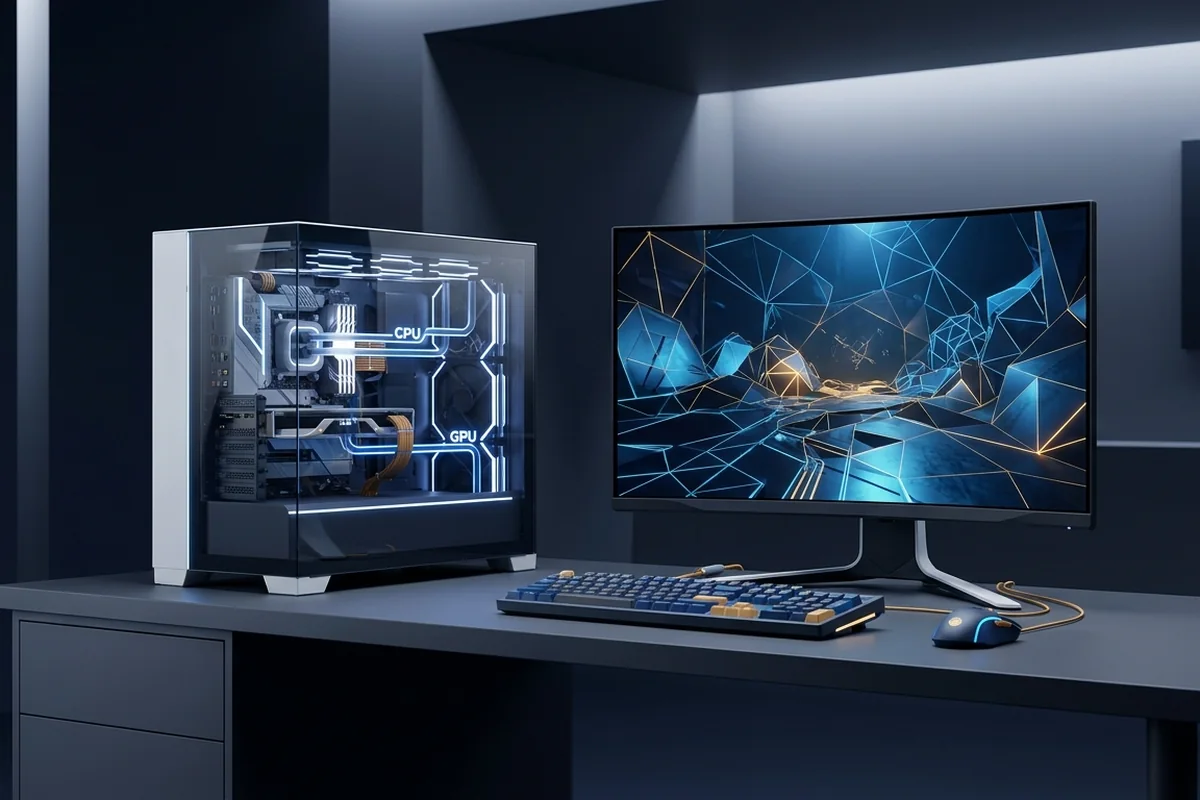
1440p increases graphics work substantially over 1080p without the full cost of 4K. It is therefore a useful balance point: fast GPUs matter, but 120–240 Hz monitors can still expose CPU limits.
Why pc bottlenecks at 1440p changes component pressure
The practical middle ground where CPU and GPU choices most often need to be balanced together.
Signals that support pc bottlenecks at 1440p
- Refresh target matters as much as pixel count.
- Upscaling changes internal render resolution and the balance.
- Ray tracing can move the system firmly toward the GPU.
- CPU-heavy games remain CPU-heavy regardless of display resolution.
Test pc bottlenecks at 1440p on your own system
Test pc bottlenecks at 1440p with the following controlled sequence and record the response after each change.
Controlled checks for pc bottlenecks at 1440p
- Test native and quality-upscaled modes.
- Compare 60, 120 and uncapped frame targets.
- Log both utilization and percentile lows.
- Check VRAM at the texture preset you intend to keep.
Plan settings and upgrades for pc bottlenecks at 1440p
For pc bottlenecks at 1440p, apply the lowest-risk relevant change first and repeat the original measurement before moving on.
Low-risk actions for pc bottlenecks at 1440p
- Allocate budget to both CPU consistency and GPU capacity.
- Prefer enough VRAM for your texture goals.
- Use a realistic target based on the monitor's refresh and games.
- Keep platform upgrade costs in the decision.
False positives to rule out for pc bottlenecks at 1440p
Before concluding that pc bottlenecks at 1440p is the cause, exclude these competing explanations in the original test scene.
- Upscaling can make a 1440p output render from a much lower internal resolution.
- A menu benchmark may not represent the CPU load of a live match.
- VRAM pressure can appear only at the highest texture setting.
Scenario matrix for pc bottlenecks at 1440p
| 1440p target | Likely balance | Useful check |
|---|---|---|
| 60 FPS | Frequently GPU-led on demanding presets | Lower ray tracing or resolution |
| 120-144 FPS | Pairing-dependent | Compare render-load and CPU-thread response |
| 240 FPS | CPU and engine remain critical | Check frame-preparation ceiling |
Worked example: PC Bottlenecks at 1440p
A build reaches 138 FPS at native 1440p and 171 FPS with quality upscaling. GPU use falls from full load as the frame rate approaches a CPU-side ceiling. The useful choice is whether the visual difference or the extra frames matter more, not whether the PC has one permanent bottleneck label. Repeating a crowded scene separately prevents a lightweight benchmark from hiding that transition.
Questions about pc bottlenecks at 1440p
Is 1440p more GPU-heavy?
Yes, compared with 1080p at the same settings, but a high refresh target can still be CPU-limited.
Does upscaling make it CPU-bound?
It can, because reducing internal resolution lets the GPU finish sooner.
How much VRAM is enough?
It depends on game assets, texture settings and features; monitor actual use and stutter rather than relying on one universal number.
Technical sources and further reading
The references below support the specific measurement method or technology discussed for pc bottlenecks at 1440p. Check the documented software version and system configuration before transferring a result to another PC.
