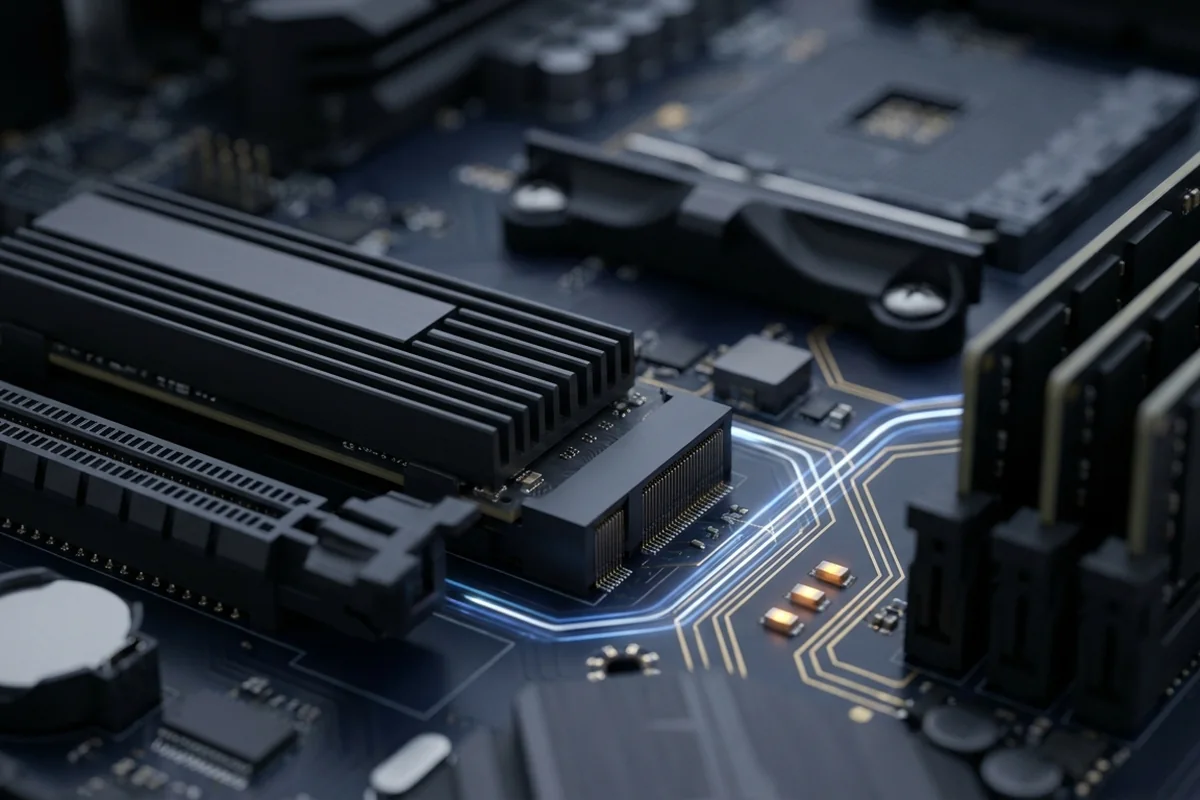
Storage rarely sets steady-state FPS, but it can interrupt frame delivery when a game streams assets, compiles caches or competes with background I/O. Capacity pressure and a nearly full drive can matter as much as peak sequential speed.
How to recognize can an ssd be a gaming bottleneck in real workloads
Separate loading-time problems from frame-rate limits and diagnose asset-streaming stalls without guesswork.
Signals that support can an ssd be a gaming bottleneck
- Loading time and rendering throughput are different performance stages.
- Random latency matters more than headline sequential speed for many game tasks.
- Paging can make a storage symptom originate in insufficient RAM.
- Drive temperature, health and free space affect sustained behavior.
How to confirm can an ssd be a gaming bottleneck with measurements
Test can an ssd be a gaming bottleneck with the following controlled sequence and record the response after each change.
Controlled checks for can an ssd be a gaming bottleneck
- Correlate frame-time spikes with disk active time and queue length.
- Check memory pressure before blaming the drive.
- Compare the same traversal after caches are warm.
- Inspect drive health, firmware and temperature.
What to change after confirming can an ssd be a gaming bottleneck
For can an ssd be a gaming bottleneck, apply the lowest-risk relevant change first and repeat the original measurement before moving on.
Low-risk actions for can an ssd be a gaming bottleneck
- Keep practical free space for updates, caches and wear management.
- Move heavily streamed games from a hard drive to an SSD.
- Stop background downloads and real-time scans during testing.
- Upgrade storage for responsiveness and consistency, not as a substitute for CPU or GPU performance.
False positives to rule out for can an ssd be a gaming bottleneck
Before concluding that can an ssd be a gaming bottleneck is the cause, exclude these competing explanations in the original test scene.
- Paging caused by insufficient RAM can make the storage graph look guilty.
- Shader compilation can coincide with disk activity without being limited by transfer speed.
- Network asset delivery or antivirus scanning can create an I/O symptom unrelated to the drive tier.
Scenario matrix for can an ssd be a gaming bottleneck
| Workload phase | Storage can affect | Storage rarely controls |
|---|---|---|
| Game launch | Loading and decompression | Peak in-game FPS |
| Open-world traversal | Asset-streaming stalls | A steady GPU-bound frame rate |
| Content creation | Cache and media reads | Compute-only render kernels |
Worked example: Can an SSD Be a Gaming Bottleneck
A game on a hard drive pauses during rapid traversal but posts the same average FPS as the SSD after the area is loaded. Disk active time aligns with each pause and RAM has spare capacity. Moving the title to an SSD improves delivery consistency, but it does not turn the GPU into a faster renderer.
Questions about can an ssd be a gaming bottleneck
Will NVMe increase FPS?
Average FPS usually changes little, but loading and asset-streaming behavior can improve.
Can a full SSD slow down?
Yes. Low free space can reduce write performance and complicate updates and caching.
Is DirectStorage always faster?
Benefits depend on game implementation, drive, CPU overhead and the rest of the pipeline.
Technical sources and further reading
The references below support the specific measurement method or technology discussed for can an ssd be a gaming bottleneck. Check the documented software version and system configuration before transferring a result to another PC.
