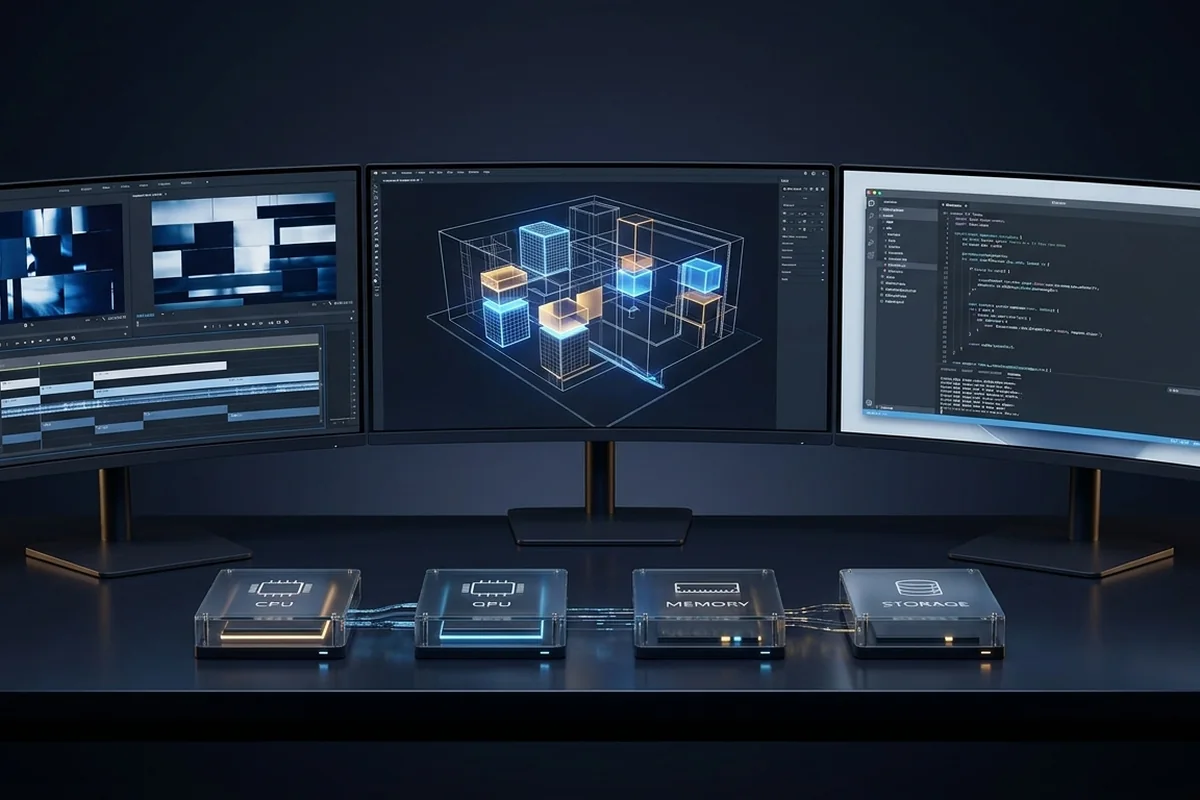
Productivity applications contain multiple pipelines. Importing, previewing, compiling, rendering and exporting can stress different components, which is why a workstation needs workflow-specific analysis rather than a single gaming score.
Map the processing stages in workstation bottlenecks
Map professional workflows to the stage that actually controls export time, preview smoothness or build speed.
Signals that support workstation bottlenecks
- Codecs and effects determine CPU versus GPU acceleration.
- Capacity limits can matter more than peak compute.
- Scratch storage and cache placement influence responsiveness.
- Software version and acceleration settings can change scaling.
Benchmark the real workstation bottlenecks workflow
Test workstation bottlenecks with the following controlled sequence and record the response after each change.
Controlled checks for workstation bottlenecks
- Time each workflow stage separately.
- Monitor CPU, GPU, VRAM, RAM and storage during the stage.
- Confirm that the intended hardware acceleration path is active.
- Use a representative project rather than a synthetic task alone.
Optimize workstation bottlenecks without moving the bottleneck
For workstation bottlenecks, apply the lowest-risk relevant change first and repeat the original measurement before moving on.
Low-risk actions for workstation bottlenecks
- Add capacity before compute when the workflow spills to disk or memory.
- Place active media and cache on suitable storage.
- Choose CPU core count versus single-thread speed for the actual application.
- Validate plug-in and codec support before choosing a GPU.
False positives to rule out for workstation bottlenecks
Before concluding that workstation bottlenecks is the cause, exclude these competing explanations in the original test scene.
- Playback, export, 3D rendering and compiling use different hardware paths.
- Codec support can matter more than generic CPU or GPU rank.
- A cache or storage wait can interrupt a compute-heavy application.
Scenario matrix for workstation bottlenecks
| Task | Common limiting resource | Measure |
|---|---|---|
| Timeline playback | Codec engine, CPU or GPU effects | Dropped frames and effect response |
| 3D render | Selected CPU or GPU device | Samples or completion time |
| Code compile | CPU, RAM and storage interaction | Clean and incremental build time |
Worked example: Workstation Bottlenecks
A workstation edits smoothly but exports slowly because its codec falls back to CPU processing. A GPU upgrade does not change that path. The operator records playback drops, export time, Blender sample rate and compile time as separate baselines. Only the export misses its target. Software media support and CPU throughput deserve investigation before memory, storage or 3D hardware.
Questions about workstation bottlenecks
Is a gaming PC a good workstation?
It can be, but reliability, memory capacity, I/O and application support may change priorities.
Do more CPU cores always help?
No. The stage must parallelize effectively.
Why is my GPU idle during export?
The codec or effect chain may be CPU-based, unsupported or configured without acceleration.
Technical sources and further reading
The references below support the specific measurement method or technology discussed for workstation bottlenecks. Check the documented software version and system configuration before transferring a result to another PC.
