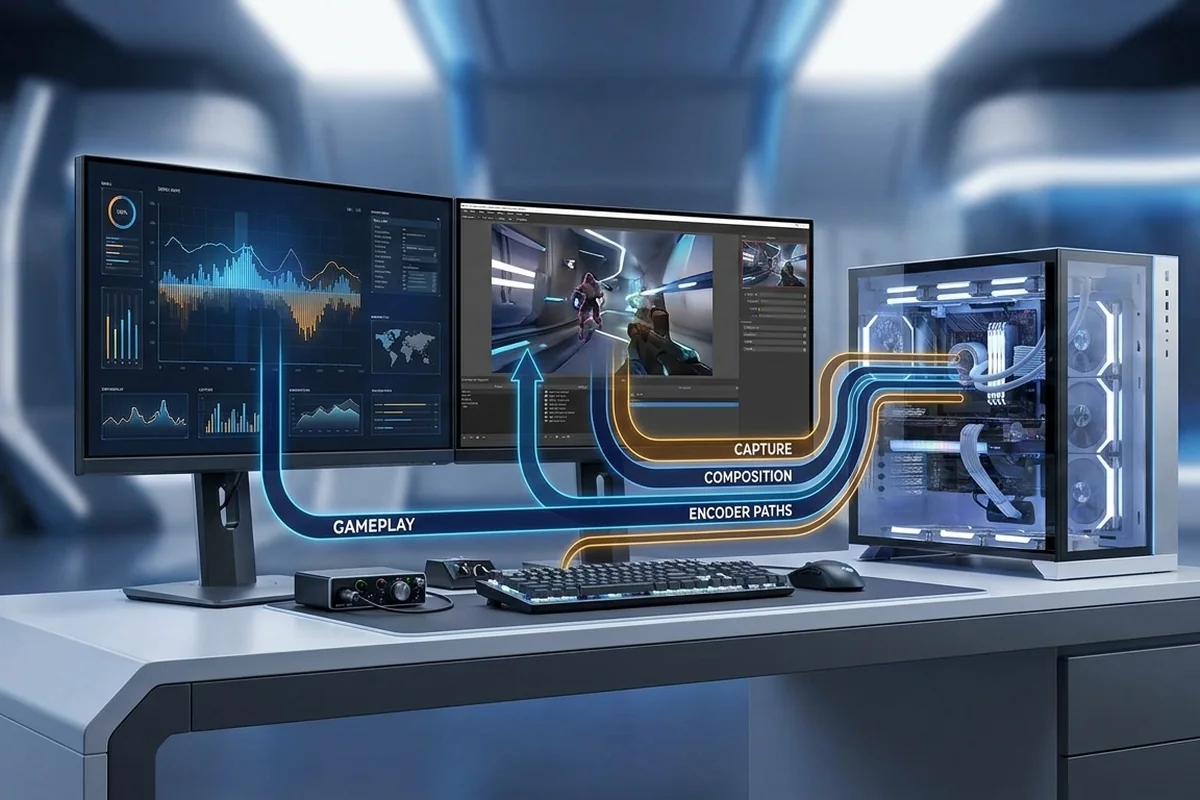
Streaming adds capture, composition, encoding and network work to a game that may already be near its limit. The best configuration protects the game's frame delivery and the encoder's deadline at the same time.
Map the processing stages in gaming and streaming bottlenecks
Understand encoder choice, capture overhead and why a stable stream begins with frame-time headroom.
Signals that support gaming and streaming bottlenecks
- Hardware encoders usually reduce CPU pressure.
- Scene composition, browser sources and filters still consume resources.
- An uncapped game can starve the encoder of GPU headroom.
- Dropped network frames and rendering lag are different problems.
Benchmark the real gaming and streaming bottlenecks workflow
Test gaming and streaming bottlenecks with the following controlled sequence and record the response after each change.
Controlled checks for gaming and streaming bottlenecks
- Separate game lag, rendering lag, encoding lag and network drops.
- Log the game while reading the streaming application's statistics.
- Test a frame cap that leaves GPU headroom.
- Disable sources and filters in groups to isolate overhead.
Optimize gaming and streaming bottlenecks without moving the bottleneck
For gaming and streaming bottlenecks, apply the lowest-risk relevant change first and repeat the original measurement before moving on.
Low-risk actions for gaming and streaming bottlenecks
- Use a supported hardware encoder when quality and workflow fit.
- Cap game FPS below the maximum unstable rate.
- Reduce preview and composition overhead.
- Upgrade the subsystem proven to miss its deadline.
False positives to rule out for gaming and streaming bottlenecks
Before concluding that gaming and streaming bottlenecks is the cause, exclude these competing explanations in the original test scene.
- Network dropped frames are not the same as render or encode lag.
- A game can remain smooth while OBS lacks GPU time to composite.
- An overloaded software encoder can resemble a game CPU bottleneck.
Scenario matrix for gaming and streaming bottlenecks
| OBS symptom | Likely path | First response |
|---|---|---|
| Rendering lag | GPU composition pressure | Cap game FPS and simplify scenes |
| Encoding overload | Encoder or CPU pressure | Review encoder and output settings |
| Dropped network frames | Connection path | Test bitrate and network stability |
Worked example: Gaming and Streaming Bottlenecks
A game uses the GPU fully and remains smooth, but the stream reports rendering lag. Capping the game below its uncapped peak leaves composition headroom and removes the missed frames. Replacing the CPU would not address this GPU-scheduling case. The OBS log shows no network drops or encoder overload, so those two paths can be excluded before changing output quality.
Questions about gaming and streaming bottlenecks
Is CPU encoding always better?
No. Modern hardware encoders can offer excellent quality with much lower game-side CPU cost.
Why does stream lag start at 99% GPU?
The composition or encoder path may not receive enough scheduling headroom.
Does faster internet fix encoding lag?
No. Network capacity does not fix local rendering or encoding delays.
Technical sources and further reading
The references below support the specific measurement method or technology discussed for gaming and streaming bottlenecks. Check the documented software version and system configuration before transferring a result to another PC.
