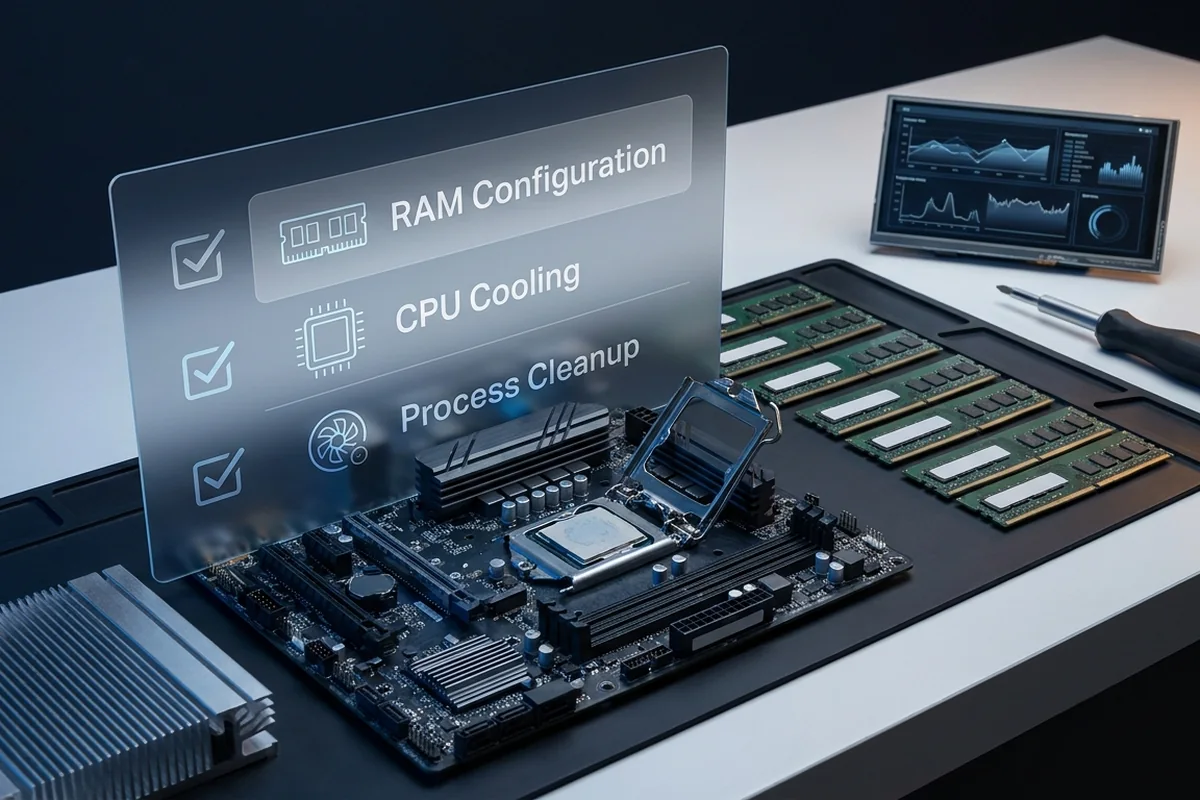
The best CPU-bottleneck fix depends on the cause. A configuration error, thermal limit or background encoder deserves a different response from an older architecture that has reached its frame-time ceiling.
Evidence to collect before changing hardware for how to fix a cpu bottleneck before you upgrade
A prioritized checklist from zero-cost process cleanup to platform replacement.
Signals that support how to fix a cpu bottleneck before you upgrade
- Confirm the limit before changing hardware.
- Fix lost performance before buying more performance.
- Game settings can affect CPU workload even when labelled as graphics options.
- A CPU upgrade can require a motherboard, memory and cooler budget.
Prove whether how to fix a cpu bottleneck before you upgrade is the correct upgrade target
Test how to fix a cpu bottleneck before you upgrade with the following controlled sequence and record the response after each change.
Controlled checks for how to fix a cpu bottleneck before you upgrade
- Repeat the controlled low-resolution test.
- Check effective clocks, temperatures and per-core load.
- Verify memory profile, channel layout and stable firmware.
- Measure the cost of streaming, browsers and overlays.
Apply how to fix a cpu bottleneck before you upgrade fixes in cost-and-risk order
For how to fix a cpu bottleneck before you upgrade, apply the lowest-risk relevant change first and repeat the original measurement before moving on.
Low-risk actions for how to fix a cpu bottleneck before you upgrade
- Close unnecessary work and use a stable power configuration.
- Reduce crowd, simulation, view-distance or object-density settings.
- Apply a sustainable frame cap.
- If upgrading, compare full platform cost and measured uplift in your games.
False positives to rule out for how to fix a cpu bottleneck before you upgrade
Before concluding that how to fix a cpu bottleneck before you upgrade is the cause, exclude these competing explanations in the original test scene.
- A frame cap can mimic a hard CPU ceiling.
- Disabled memory profiles can reduce CPU-side performance without requiring a new processor.
- Thermal throttling must be fixed before comparing CPU tiers.
Scenario matrix for how to fix a cpu bottleneck before you upgrade
| Fix | Cost and risk | Validation |
|---|---|---|
| Close background work | Free and low risk | Repeat the same capture |
| Verify memory profile and channels | Free with stability testing | Check configured rate and lows |
| Platform upgrade | High cost | Require a proven remaining target gap |
Worked example: How to Fix a CPU Bottleneck Before You Upgrade
A system misses its 144 FPS target while the memory kit runs at its fallback rate. Enabling the supported profile and removing a background recorder improves the repeatable low-percentile result enough to meet the goal. An expensive CPU and motherboard replacement is no longer justified.
Questions about how to fix a cpu bottleneck before you upgrade
Will overclocking solve it?
Sometimes it provides a small uplift, but modern boost behavior, cooling and stability limit the gain.
Should I increase resolution?
That can improve utilization balance but does not raise the CPU's maximum frame rate.
When should I upgrade?
When the proven CPU ceiling remains below your target after configuration and thermal issues are resolved.
Technical sources and further reading
The references below support the specific measurement method or technology discussed for how to fix a cpu bottleneck before you upgrade. Check the documented software version and system configuration before transferring a result to another PC.
